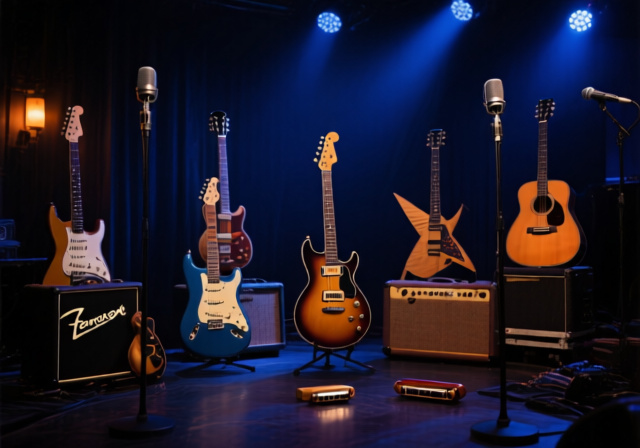
Blues guitarists are the soulful storytellers who gave voice to the African American experience, transforming raw emotion into six-string poetry that would become the foundation of virtually all modern American music. These artists didn’t just play guitar—they made their instruments sing, cry, and speak with a voice that resonated through generations.
The best blues guitarists combine technical mastery with raw emotional expression, using techniques like string bending, vibrato, and slide playing to create the distinctive sounds that define the genre. From the Delta fields of Mississippi to the electric clubs of Chicago, these musicians developed styles that continue to influence guitarists across every genre of music.
In this comprehensive guide, we’ll explore the 15 most influential blues guitarists of all time, examining their unique playing styles, historical significance, and lasting impact on music. Whether you’re a budding guitarist looking to learn the blues or simply a music lover wanting to understand the roots of rock, jazz, and popular music, this list will guide you through the essential artists who shaped the blues landscape.
The Evolution of Blues Guitar
Blues guitar didn’t emerge in a vacuum—it evolved from rich musical traditions and cultural circumstances that gave birth to one of America’s most significant art forms. Understanding this evolution helps us appreciate why certain guitarists stand out as revolutionary figures in music history.
Regional Roots and Styles
The blues developed in distinct regional styles, each with its own guitar techniques and musical characteristics. Delta blues, originating in Mississippi, featured acoustic guitarists like Robert Johnson who used intricate fingerpicking patterns and slide techniques. Chicago blues emerged when musicians migrated north, electrifying their sound and creating the template for modern blues. Texas blues brought its own flavor with swing rhythms and sophisticated single-string solos pioneered by T-Bone Walker.
Technical Innovation
Blues guitarists continuously pushed the boundaries of what was possible on the instrument. They developed techniques that are now standard across all guitar styles: expressive string bending that mimics the human voice, soulful vibrato that adds emotional depth, and slide guitar playing that creates haunting, vocal-like melodies. These innovations weren’t just technical exercises—they were tools for expressing the full range of human emotion.
Cultural Impact
The blues guitar tradition represents more than just music—it’s a cultural legacy that has influenced social movements, artistic expression, and musical innovation worldwide. From the field recordings of the 1920s to the stadium-filling blues-rock of today, the guitar has remained the central voice of the blues, carrying stories of struggle, joy, love, and resilience across generations.
15 Most Influential Blues Guitarists
1. Robert Johnson – The Crossroads Legend
Robert Johnson stands as the most mythologized figure in blues history, a guitarist whose influence far outweighs his brief recording career. His intricate fingerpicking patterns and ability to sound like two guitarists playing simultaneously created a template that still challenges players today. The legend of selling his soul at the crossroads only adds to his mystique, but it’s his musical innovations that truly secured his legacy.
Johnson’s technical brilliance lay in his use of alternating bass patterns combined with syncopated melodies, creating a full sound that belied the fact he was playing alone. His slide work on tracks like “Cross Road Blues” demonstrates perfect intonation and emotional control, while his vocal-influenced bending on “Sweet Home Chicago” set a standard for expressive playing that remains unmatched.
What makes Johnson special isn’t just his technical skill, but how he used it to convey profound emotional depth. His songs capture loneliness, desire, and spiritual yearning with an intensity that feels immediate even 90 years after they were recorded. Every blues guitarist who followed stands on his shoulders, whether they know it or not.
2. Muddy Waters – The Father of Modern Chicago Blues
If Robert Johnson planted the seeds of blues guitar, Muddy Waters cultivated them into the electric forest that would dominate the genre for decades. Waters took the acoustic Delta sound he learned in Mississippi and electrified it, creating the template for Chicago blues and, by extension, rock and roll. His slide guitar work, often played on an electric Fender Telecaster, brought unprecedented power and expressiveness to the instrument.
Waters’ playing style was deceptively simple—based on driving shuffle rhythms and economical phrasing—but executed with perfect timing and tone. His use of distortion, created by turning small amplifiers up to maximum volume, became the blueprint for electric blues tone. On tracks like “Hoochie Coochie Man,” his guitar and voice work in perfect call-and-response, creating a dialog that feels both spontaneous and precisely controlled.
Beyond his technical innovations, Waters understood performance and stage presence. He commanded attention with his physical style of playing, often crouching over his guitar as if in conversation. This theatrical approach, combined with his musical innovations, made him the bridge between country blues and the electrified urban sound that would inspire generations of rock musicians.
3. B.B. King – The King of Blues Guitar
B.B. King elevated blues guitar to an art form of sophisticated expression, proving that sometimes the most powerful statements come from playing fewer notes with more feeling. His approach, which he often described as “making the guitar sing,” focused on impeccable phrasing, tasteful vibrato, and the ability to say more with one perfectly bent note than many players say with twenty.
King’s signature technique was his butterfly vibrato—a wide, controlled shaking of the string that created a vocal-like quality unprecedented in blues guitar. He developed this style early in his career and refined it over decades, eventually creating what many consider the definitive blues guitar tone. His use of the Gibson ES-335, nicknamed “Lucille,” became iconic, as did his habit of never playing and singing simultaneously, allowing each to receive full attention.
What truly sets King apart is his emotional intelligence as a player. He understood that blues guitar isn’t just about technique—it’s about storytelling. On classics like “The Thrill Is Gone,” every note serves the emotional narrative, building tension and release with the precision of a master filmmaker. His influence extends far beyond blues, impacting rock, jazz, and pop guitarists who recognize the power of restraint and expression.
4. Albert King – The Left-Handed Giant
Albert King flipped the script—literally—by playing a right-handed Flying V guitar upside down and backwards without restringing it. This unconventional approach created his signature sound, with the thickest string at the bottom allowing him to bend notes upward in a way that gave his playing a unique vocal quality. His influence can be heard in everyone from Stevie Ray Vaughan to Eric Clapton, yet few could match his distinctive style.
King’s playing was characterized by powerful, wide bends that seemed to defy physics, achieved by his unusual string setup and massive hand strength. He could bend the low E string up a full fourth interval—a technique most guitarists find impossible even on lighter strings. This physical approach, combined with his economic phrasing, made each note carry maximum emotional weight.
On tracks like “Born Under a Bad Sign,” King demonstrates the perfect balance between raw power and melodic sophistication. His solos build logically, using space as effectively as notes, and his tone—achieved through a Gibson Flying V through a variety of amplifiers—remains one of the most sought-after sounds in blues guitar history. He proved that blues didn’t need to be complicated to be profound, just deeply felt.
5. Freddie King – The Texas Cannonball
Freddie King brought an aggressive, percussive approach to blues guitar that bridged the gap between Chicago blues and the emerging blues-rock sound. His mastery of both fingerstyle and pick techniques made him versatile and influential, while his energetic stage presence earned him the nickname “The Texas Cannonball.” King’s playing combined the sophistication of jazz with the raw emotion of blues, creating a style that appealed to diverse audiences.
King’s breakthrough instrumental “Hide Away” became a rite of passage for blues guitarists, featuring clever melodic hooks and sophisticated chord progressions that showcased his jazz influences. His use of hybrid picking—combining pick and fingers—allowed him to create complex textures and rapid-fire licks that influenced players across genres. On vocal tracks like “Have You Ever Loved a Woman,” his guitar work serves as a second voice, answering and echoing his singing with emotional intensity.
What made King special was his ability to balance technical prowess with deep emotional expression. He could play with blinding speed when the music called for it, but he never let technique override feeling. His influence can be heard in blues-rock players like Eric Clapton and modern blues masters like Joe Bonamassa, both of whom cite King as a primary influence.
6. Howlin’ Wolf – The Powerful Voice of Chicago Blues
While primarily known for his towering voice and imposing stage presence, Howlin’ Wolf was also a formidable guitarist whose rhythm playing anchored some of Chicago blues’ most enduring recordings. Standing over six feet tall and weighing nearly 300 pounds, Wolf was an intimidating figure whose guitar style matched his physical presence—powerful, direct, and unshakeable.
Wolf’s guitar approach emphasized rhythm over flash, providing the solid foundation that allowed his legendary backing musicians like Hubert Sumlin to shine. His slide work, particularly on early acoustic recordings like “Smokestack Lightnin’,” shows the direct influence of Delta blues masters like Charley Patton. When he switched to electric guitar, he brought the same rhythmic intensity, creating driving patterns that powered Chess Records’ house band.
What makes Wolf significant isn’t just his playing, but his holistic approach to blues performance. He understood that the guitar was part of a larger expressive package that included voice, movement, and stage presence. This integrated approach influenced generations of performers who recognized that blues music is about total expression, not just instrumental virtuosity.
7. T-Bone Walker – The Electric Pioneer
T-Bone Walker single-handedly invented the concept of the electric blues guitar star, combining sophisticated single-string solos with charismatic stage moves that included playing the guitar behind his back and with his teeth. His 1942 recording of “Stormy Monday” essentially created the slow blues template that thousands of guitarists would follow, while his showmanship set the standard for live performance.
Walker’s playing reflected his background in jazz and swing, featuring complex chord substitutions and melodic sophistication unheard in blues at the time. He was one of the first guitarists to use the electric guitar’s capabilities to their full extent, employing effects like reverb and tremolo to create atmospheric textures. His fluid, horn-like phrasing influenced countless jazz and blues players, proving that the guitar could be a lead instrument on par with saxophones and trumpets.
Beyond his technical innovations, Walker understood the business of music. He dressed impeccably, presented himself as a star, and demanded professional treatment—standards that helped elevate blues musicians from casual entertainers to respected artists. His influence can be heard in everyone from B.B. King (who idolized him) to Chuck Berry (who borrowed his stage moves).
8. John Lee Hooker – The Boogie King
John Lee Hooker created his own world of blues, characterized by hypnotic boogie rhythms and deeply personal singing that seemed to come straight from his soul. His unique guitar style, often featuring droning open strings and unpredictable timing, created a trance-like quality that set him apart from more structured Chicago blues players. Hooker proved that blues didn’t need to follow conventional rules to be powerful.
Hooker’s signature boogie pattern, first heard on his 1948 hit “Boogie Chillen’,” became one of the most recognizable guitar riffs in music history. His approach was deeply personal—he often played in different keys than his accompaniment and followed his own internal timing, creating a tension that made his performances feel alive and unpredictable. This raw, unpolished approach would later inspire punk and alternative musicians who valued authenticity over technical perfection.
What makes Hooker essential is his emotional authenticity. Whether playing alone with his guitar or with a full band, he maintained a direct connection to the blues’ deepest emotions. His late-career collaborations with rock musicians like Carlos Santana and Bonnie Raitt introduced him to new generations, proving that genuine emotion transcends musical boundaries.
9. Sister Rosetta Tharpe – The Godmother of Rock & Roll
Sister Rosetta Tharpe was a true pioneer who combined gospel fervor with blues guitar techniques, creating a template for rock and roll a decade before it supposedly began. As a Black woman dominating the male-dominated world of guitar in the 1930s and 40s, she broke barriers and created music that influenced everyone from Little Richard to Chuck Berry to Elvis Presley.
Tharpe’s playing was characterized by energetic, aggressive strumming and sophisticated single-note lines that blended gospel melodies with blues sensibility. She was one of the first artists to intentionally use distortion as an expressive tool, pushing small amplifiers to their limits to create a gritty sound that would become a rock and roll staple. Her performances were electrifying—she played the guitar with technical virtuosity while singing with the power of a gospel shout.
Beyond her musical innovations, Tharpe was a trailblazer who refused to be limited by genre, gender, or racial expectations. She played gospel music in blues clubs and blues techniques in church services, breaking down barriers and expanding the possibilities for all musicians who followed. Her influence on rock guitar is profound, yet her contributions were long overlooked by mainstream music history.
10. Stevie Ray Vaughan – The Texas Blues Revivalist
Stevie Ray Vaughan burst onto the 1980s music scene like a force of nature, reigniting interest in blues guitar with a combination of technical virtuosity and raw emotional power that hadn’t been seen since the genre’s heyday. Playing heavy strings on a battered Stratocaster through cranked Fender amplifiers, SRV created a sound that was both deeply traditional and radically modern, proving that blues could still be relevant in the age of synthesizers and drum machines.
Vaughan’s playing was characterized by aggressive attack, massive bends, and thunderous vibrato that required incredible physical strength and control. He could play with the finesse of his idol Albert King or unleash torrents of notes that rivaled the fastest rock shredders, always serving the emotional needs of the song. His rhythm playing was equally impressive, driving songs like “Pride and Joy” with a percussive shuffle that became his signature.
What made SRV special was his ability to synthesize diverse influences into a cohesive personal style. He absorbed the blues of Albert King, the jazz of Django Reinhardt, the rock of Jimi Hendrix, and the soul of Otis Redding, creating music that felt both authentic and innovative. His tragic death at 35 cut short a career that might have redefined blues guitar for decades to come.
11. Eric Clapton – The British Blues Ambassador
Eric Clapton served as the primary conduit through which American blues reached young white audiences in the 1960s, first with John Mayall & the Bluesbreakers, then with Cream, and finally as a solo artist. His dedication to the blues tradition, combined with his natural talent and charismatic stage presence, helped elevate blues guitar to the status of high art in popular music.
Clapton’s early work with the Bluesbreakers established him as a guitar prodigy, with solos that combined the vocabulary of B.B. King and Freddie King with his own melodic sensibility. His tone—achieved through a Gibson Les Paul through a Marshall amplifier—became the blueprint for blues-rock guitar, influencing generations of players. With Cream, he expanded the possibilities of blues-rock through extended improvisations that pushed the boundaries of conventional song structures.
What makes Clapton significant is his role as a curator and popularizer of the blues. He introduced mainstream audiences to the music of Robert Johnson, Howlin’ Wolf, and other blues masters through faithful covers and enthusiastic endorsements. While later in his career he moved toward pop and adult contemporary styles, his blues foundation always remained evident, and he continued to champion blues artists throughout his career.
12. Buddy Guy – The Showman of Chicago Blues
Buddy Guy represents the living bridge between Chicago blues’ golden age and its modern incarnation, combining the tradition of Muddy Waters with theatrical showmanship that influenced Jimi Hendrix and countless rock performers. His ability to switch from gentle, nuanced playing to explosive, feedback-drenched solos demonstrates the full emotional range of blues guitar.
Guy’s playing is characterized by its unpredictability and emotional intensity. He can play with the delicate touch of B.B. King one moment and unleash torrents of notes the next, always in service of the song’s emotional needs. His use of feedback and distortion predates Jimi Hendrix, and his stage antics—playing with his teeth, behind his back, or while dangling from rafters—expanded the possibilities of live performance.
What makes Guy essential is his longevity and adaptability. He weathered the decline of blues popularity in the 1970s, experienced a career renaissance in the 1990s, and continues to tour and record into his 80s. His 1991 album “Damn Right, I’ve Got the Blues” marked a major blues revival, and his mentorship of younger players ensures the tradition continues to evolve.
13. Bonnie Raitt – The Queen of Modern Blues
Bonnie Raitt broke barriers as a woman in the male-dominated blues world, combining sophisticated guitar technique with soulful singing and songwriting that speaks to contemporary audiences. Her mastery of slide guitar, learned from studying masters like Mississippi Fred McDowell, brought the tradition to new listeners who might never have discovered it otherwise.
Raitt’s playing is notable for its taste and emotional intelligence rather than technical fireworks. She uses slide guitar not as a gimmick but as an expressive tool, creating vocal-like melodies that complement her singing perfectly. Her rhythm playing is equally impressive, providing a solid foundation for her songs while leaving space for her tasteful lead work.
Beyond her guitar skills, Raitt’s significance lies in her ability to blend blues with other genres—folk, rock, pop, and country—creating music that feels authentic yet accessible to mainstream audiences. Her commercial breakthrough in the 1990s with albums like “Nick of Time” proved that blues-based music could still achieve massive popular success without compromising its artistic integrity.
14. Joe Bonamassa – The Modern Blues Virtuoso
Joe Bonamassa represents the modern face of blues guitar, combining the technical sophistication of rock virtuosos with deep reverence for blues tradition. His ability to play in virtually any style—from Delta acoustic to hard rock blues—while maintaining authentic blues feeling has made him one of the most successful blues artists of the 21st century.
Bonamassa’s playing is characterized by its precision and versatility. He can execute complex jazz chords, lightning-fast rock runs, and deeply felt blues phrases with equal facility, often within the same song. His knowledge of guitar history and gear is encyclopedic, allowing him to recreate classic tones while creating his own distinctive sound that balances vintage warmth with modern clarity.
What makes Bonamassa significant is his role in keeping blues vital in the digital age. Through his extensive touring, record label, and festivals, he’s created an infrastructure that supports blues musicians and introduces the genre to new generations. While some critics argue his playing can be overly technical, his dedication to the blues tradition is unquestionable, as evidenced by his collaborations with remaining blues legends like B.B. King and Buddy Guy.
15. Samantha Fish – The Future of Blues Guitar
Samantha Fish represents the new generation of blues guitarists who are redefining the genre for contemporary audiences, bringing youthful energy and modern sensibilities while respecting the tradition. Her emergence as a leading voice in blues guitar proves the genre’s continued relevance and evolution in the 21st century.
Fish’s playing combines blues technique with rock energy and pop sensibilities, creating a sound that appeals to diverse audiences. Her slide work shows the influence of Bonnie Raitt and Sonny Landreth, while her lead playing incorporates modern rock elements that connect with younger listeners. She’s equally comfortable playing acoustic Delta blues or high-energy blues-rock, demonstrating versatility that keeps her music fresh and unpredictable.
What makes Fish significant is her role in expanding the audience for blues guitar. As a young woman in a genre still dominated by male artists, she brings new perspectives and attracts new listeners who might not otherwise discover the blues. Her collaborations with artists across genres and her willingness to experiment with different sounds while maintaining blues fundamentals suggest exciting directions for the genre’s future.
Blues Guitar in the Modern Era
The blues guitar tradition continues to evolve in the digital age, with artists finding new ways to express timeless emotions through modern tools and platforms. Streaming services have made the entire history of blues guitar accessible to anyone with an internet connection, while social media allows new artists to build audiences without traditional industry gatekeepers.
Modern blues guitarists are expanding the genre’s boundaries by incorporating elements from rock, jazz, hip-hop, and world music. Artists like Gary Clark Jr. blend blues with alternative rock and hip-hop sensibilities, while instrumentalists like Christone “Kingfish” Ingram bring virtuosic technique and youthful energy to traditional blues forms. This cross-pollination keeps the blues fresh and relevant while honoring its roots.
The global reach of blues guitar has also expanded dramatically, with passionate scenes emerging in Europe, South America, and Asia. International blues festivals draw massive crowds, and guitarists from diverse cultural backgrounds are adding their own perspectives to the tradition. This globalization ensures that blues guitar will continue to evolve and adapt while maintaining its core emotional truth.
The Enduring Legacy of Blues Guitar
The guitarists on this list didn’t just play music—they created a language of emotion that continues to speak to new generations. Their innovations in technique, tone, and expression form the foundation of virtually all popular guitar music, from rock to country to jazz. Understanding their contributions isn’t just an academic exercise—it’s essential knowledge for anyone who wants to fully grasp the evolution of American music.
For guitarists looking to learn the blues, start by listening deeply to these masters. Don’t just focus on the notes they play—pay attention to the space between notes, the dynamics, the subtle variations in timing that give blues its distinctive feel. Remember that blues guitar is about expression first and technique second. As B.B. King often said, it’s not how many notes you play, but which notes you choose and how you play them.
The future of blues guitar looks bright, with a new generation of artists carrying the tradition forward while making it their own. As long as there are stories to tell and emotions to express, the blues will continue to evolve, finding new voices through the six strings of a guitar. The journey these masters began continues with every player who picks up a guitar with something to say.