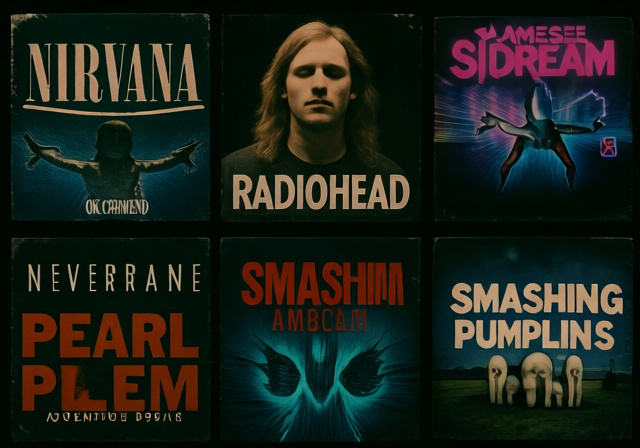
The 1990s wasn’t just a decade—it was a musical revolution that forever changed how we think about rock music. As the glossy excess of the 80s gave way to something rawer, more authentic, and unapologetically real, alternative rock emerged as the voice of a generation searching for meaning in a rapidly changing world.
The best 90s alternative bands didn’t just write songs—they created movements, challenged conventions, and gave voice to the anxieties, hopes, and contradictions of their time. From the muddy waters of Seattle’s grunge scene to the dance floors of Manchester’s Madchester movement, from the swirling atmospherics of shoegaze to the anthemic britpop that dominated the UK charts, alternative music in the 90s was as diverse as it was influential.
Having spent countless hours immersed in the music of this era—both as a fan and as someone who’s interviewed musicians, attended festivals, and watched these movements unfold in real time—I’ve compiled what I believe are the 30 most essential alternative bands of the 1990s. This isn’t just a popularity contest; it’s a celebration of the artists who pushed boundaries, created lasting legacies, and continue to inspire musicians today.
My ranking considers not just chart success, but cultural impact, musical innovation, and lasting influence on subsequent generations. From the obvious icons to the cult favorites that defined specific subgenres, here are the bands that made the 90s alternative scene so unforgettable.
The 30 Essential 90s Alternative Bands
1. Nirvana
No discussion of 90s alternative music can begin without Nirvana. The trio from Aberdeen, Washington, didn’t just popularize grunge—they mainstreamed alternative rock itself. “Nevermind” (1991) was more than an album; it was a cultural reset that knocked Michael Jackson from the top of the charts and signaled the end of hair metal’s dominance.
Kurt Cobain’s songwriting combined raw emotion with deceptively catchy melodies, creating anthems like “Smells Like Teen Spirit” that captured the disillusionment of Generation X. The band’s three-album catalog—”Bleach” (1989), “Nevermind” (1991), and “In Utero” (1993)—remains a masterclass in blending punk energy with pop sensibilities. Cobain’s tragic death in 1994 only cemented Nirvana’s legendary status, making them the most influential alternative band of the decade.
2. Radiohead
If Nirvana represented the raw, emotional side of 90s alternative, Radiohead embodied its artistic ambition. Starting with the anthemic “Creep” in 1992, the Oxford quintet initially seemed like standard alt-rock fare. But with “The Bends” (1995) and especially “OK Computer” (1997), they transcended the genre to create something entirely new.
“OK Computer” stands as perhaps the definitive statement of pre-millennial anxiety, with Thom Yorke’s haunting vocals and Jonny Greenwood’s innovative guitar work painting a portrait of technological alienation that feels even more relevant today. The band’s willingness to experiment—from the glitchy electronics of “Kid A” (2000) to the orchestral beauty of “In Rainbows” (2007)—has influenced countless artists across genres.
3. Pearl Jam
Pearl Jam emerged from the same Seattle scene as Nirvana but carved out their own unique path. Their 1991 debut “Ten” was a slow-burning phenomenon that, along with Nirvana’s “Nevermind,” brought grunge to the masses. Eddie Vedder’s baritone vocals and the band’s classic rock-inspired musicianship made them arena-rock stars who never lost their alternative cred.
What set Pearl apart was their longevity and integrity. After achieving massive success, they famously battled Ticketmaster over ticket prices, refused to make music videos for years, and continued to evolve musically. Albums like “Vs.” (1993), “Vitalogy” (1994), and “No Code” (1996) showed a band willing to take risks while maintaining their connection with fans.
4. R.E.M.
While R.E.M. formed in the early 80s and helped define college rock, the 90s saw them reach commercial superstardom without sacrificing their artistic vision. Albums like “Out of Time” (1991) and “Automatic for the People” (1992) featured some of the decade’s most enduring songs, including “Losing My Religion,” “Man on the Moon,” and “Everybody Hurts.”
Michael Stipe’s distinctive vocals and enigmatic lyrics, Peter Buck’s jangly guitar work, and the band’s commitment to political and environmental causes made them alternative icons. Their influence extended beyond music—they showed that you could maintain artistic integrity while achieving massive success.
5. The Smashing Pumpkins
Few bands embodied the ambitious excess of the 90s like The Smashing Pumpkins. Led by the prolific and often volatile Billy Corgan, the Chicago-based band created grand, guitar-heavy epics that blended alternative rock with progressive rock ambitions. Their 1993 masterpiece “Siamese Dream” and the double-album “Mellon Collie and the Infinite Sadness” (1995) defined alternative rock’s blockbuster potential.
The Pumpkins’ sound—characterized by Corgan’s distinctive vocals, layered guitars, and dynamics ranging from whisper-quiet to ear-splittingly loud—influenced countless bands. Their willingness to experiment with different styles, from the gothic atmosphere of “Adore” (1998) to the electronic elements of “Machina/The Machines of God” (2000), showed remarkable artistic range.
6. Sonic Youth
If any band can be called the godparents of alternative rock, it’s Sonic Youth. Formed in New York in 1981, the quartet spent the 80s pioneering alternative guitar techniques and noise rock aesthetics. In the 90s, they signed to a major label and created some of their most accessible work, including “Goo” (1990) and “Dirty” (1992).
Thurston Moore and Lee Ranaldo’s unconventional guitar tunings and use of feedback, Kim Gordon’s bass lines and feminist perspective, and Steve Shelley’s powerful drumming created a template that influenced countless alternative and indie bands. Their 1991 collaboration with Iggy Pop, “Brick by Brick,” and their 1994 album “Experimental Jet Set, Trash and No Star” showed their continued relevance in the alternative landscape.
7. Pixies
Like R.E.M., the Pixies formed in the 80s but their influence exploded in the 90s. Their signature “loud-quiet-loud” dynamics and surreal lyrics directly influenced Nirvana, and their 1989 album “Doolittle” is regularly cited as one of the greatest alternative albums ever recorded.
The band’s 1990-1993 hiatus only added to their mystique, and when they reunited in the early 2000s, they were recognized as one of the most important American rock bands of all time. Songs like “Where Is My Mind?” (featured in “Fight Club”) and “Debaser” continue to appear in films and commercials, proving their enduring cultural impact.
8. Oasis
Oasis represented the Britpop movement’s swagger and ambition. Formed in Manchester by brothers Noel and Liam Gallagher, the band combined Beatles-esque melodies with working-class attitude and rock star excess. Their 1994 debut “Definitely Maybe” and 1995’s “(What’s the Story) Morning Glory?” made them international superstars.
Songs like “Live Forever,” “Wonderwall,” and “Champagne Supernova” became generational anthems, while the Gallagher brothers’ feuds provided endless tabloid fodder. Oasis’s influence extended beyond music—they defined 90s British culture and inspired countless guitar-based bands in their wake.
9. Blur
If Oasis were the working-class heroes of Britpop, Blur were its art-school intellectuals. Formed in London in 1988, the band evolved from Madchester-inspired dance-rock to become Britpop standard-bearers with their 1994 album “Parklife.” The rivalry between Blur and Oasis defined British pop culture in the mid-90s.
Damon Albarn’s witty, observational lyrics about British life, Graham Coxon’s innovative guitar work, and the band’s musical versatility made them more than just a Britpop band. Later albums like “Blur” (1997) and “13” (1999) showed their willingness to experiment, paving the way for Albarn’s later work with Gorillaz.
10. Nine Inch Nails
Trent Reznor’s Nine Inch Nails brought industrial music into the alternative mainstream. The 1989 debut “Pretty Hate Machine” blended electronic beats with rock aggression, but it was 1994’s “The Downward Spiral” that cemented Reznor’s status as an alternative icon.
NIN’s fusion of electronic music, metal, and punk created a sound that was both innovative and commercially successful. Reznor’s dark, introspective lyrics about addiction, depression, and alienation resonated with a generation of alternative fans. The band’s influence can be heard in everything from industrial metal to electronic music.
11. Green Day
Green Day brought punk rock back to the mainstream in the mid-90s. Formed in the Bay Area in 1987, the band had built a following in the punk underground before signing to a major label and releasing “Dookie” in 1994. The album’s catchy, three-chord punk anthems like “Basket Case” and “When I Come Around” made the band superstars.
What set Green Day apart was their songwriting craft—Billie Joe Armstrong had a knack for writing hooks that could appeal to both punk purists and pop fans. Their success paved the way for the pop-punk explosion of the late 90s and early 2000s.
12. Beck
Beck Hansen emerged as one of the 90s most innovative and unpredictable artists. After his slacker anthem “Loser” became an unlikely hit in 1994, he confounded expectations with each subsequent release. “Mellow Gold” (1994) blended folk, hip-hop, and rock, while “Odelay” (1996) featured cutting-edge production by the Dust Brothers.
Beck’s ability to seamlessly blend genres—from the country-folk of “Mutations” (1998) to the party funk of “Midnite Vultures” (1999)—made him one of the decade’s most unique voices. His influence can be heard in countless indie and alternative artists who refuse to be confined by genre boundaries.
13. The Cure
Like R.E.M. and Pixies, The Cure formed in the late 70s/early 80s but had a major impact on 90s alternative music. Their gothic post-punk sound influenced countless bands, and their 1992 album “Wish” showed they could still create compelling music. Songs like “Friday I’m In Love” proved they could write upbeat pop songs without losing their dark edge.
Robert Smith’s distinctive voice, back-combed hair, and mascara defined goth aesthetics for a generation. The band’s influence extended beyond music—they created an entire visual and emotional vocabulary that alternative artists continue to draw from today.
14. Red Hot Chili Peppers
The Red Hot Chili Peppers spent the 80s building a following with their unique blend of funk, punk, and rock. In the 90s, they became alternative superstars with albums like “Blood Sugar Sex Magik” (1991), which featured hits like “Give It Away” and “Under the Bridge.”
Anthony Kiedis’s stream-of-consciousness lyrics, Flea’s virtuosic bass playing, John Frusciante’s Hendrix-inspired guitar work, and Chad Smith’s powerful drumming created a sound that was both innovative and accessible. The band’s funk-rock fusion influenced countless alternative and nu-metal bands.
15. Foo Fighters
Few bands have a more interesting origin story than Foo Fighters. After Kurt Cobain’s death, Nirvana drummer Dave Grohl retreated to a studio and recorded an album’s worth of songs on his own, playing every instrument himself. The resulting self-titled 1995 debut launched Grohl’s second act as a frontman.
What began as a solo project evolved into a proper band that became one of alternative rock’s most reliable hit-makers. Albums like “The Colour and the Shape” (1997) and “There Is Nothing Left to Lose” (1999) showed Grohl’s knack for writing arena-sized rock anthems with emotional depth. The Foo Fighters proved that you could achieve massive success without losing your alternative credibility.
16. Björk
Iceland’s Björk Guðmundsdóttir defied categorization throughout the 90s. After leaving her band The Sugarcubes, she embarked on a solo career that produced some of the decade’s most innovative music. “Debut” (1993) blended electronic music with pop sensibilities, while “Post” (1995) and “Homogenic” (1997) pushed further into experimental territory.
Björk’s otherworldly voice, theatrical performances, and willingness to collaborate with cutting-edge producers made her a true original. Her influence extends beyond alternative music into electronic, art pop, and avant-garde circles. She proved that alternative music could be both intellectually challenging and emotionally resonant.
17. Jane’s Addiction
Jane’s Addiction were crucial bridging figures between 80s alternative and 90s alternative rock. Their 1988 debut “Nothing’s Shocking” and 1990’s “Ritual de lo Habitual” combined Perry Farrell’s theatrical vocals, Dave Navarro’s virtuosic guitar work, and a rhythm section that could handle both funk and metal.
More importantly, Farrell founded Lollapalooza in 1991, creating the touring festival that would define alternative culture for much of the decade. The band’s influence can be heard in everything from alt-metal to art rock, and their reunion tours continue to draw massive crowds.
18. My Bloody Valentine
Few bands were as influential with as little mainstream success as My Bloody Valentine. The Irish-English band pioneered the shoegaze movement with their unique blend of buried vocals, massive guitar walls, and dreamy atmospherics. Their 1991 album “Loveless” is widely regarded as a masterpiece that influenced generations of indie and alternative artists.
Kevin Shields’ innovative guitar techniques—using tremolo arms and reverse reverb to create oceanic waves of sound—created a sonic template that bands continue to emulate today. The band’s 22-year gap between albums only added to their mystique, and their 2013 comeback proved their enduring influence.
19. The Stone Roses
The Stone Roses defined the Madchester scene of the late 80s and early 90s. Their 1989 self-titled debut album blended indie rock with dance music influences, creating a sound that would influence Britpop and beyond. Songs like “I Wanna Be Adored” and “Fools Gold” became anthems of the era.
The band’s 1994 follow-up “The Second Coming” was delayed for years due to legal issues, but when it finally arrived, it showed the band’s rock influences more prominently. Ian Brown’s cool, detached vocals and John Squire’s Hendrix-inspired guitar playing made them style icons as much as musical innovators.
20. Pavement
Pavement embodied the lo-fi indie aesthetic that became an important part of 90s alternative music. Formed in California, the band recorded their early releases on four-track cassette, creating a deliberately rough sound that contrasted with the polished production of mainstream rock.
Stephen Malkmus’s cryptic lyrics and laconic vocals, combined with Scott Kannberg’s melodic guitar work, created a sound that was both challenging and catchy. Albums like “Slanted and Enchanted” (1992) and “Crooked Rain, Crooked Rain” (1994) influenced the entire indie rock movement of the 90s and beyond.
21. Weezer
Weezer brought power-pop sensibilities to alternative rock. Their 1994 self-titled debut (known as “The Blue Album”) featured perfectly crafted three-minute songs about insecurity, geek culture, and unrequited love. “Buddy Holly” and “Say It Ain’t So” became alternative radio staples.
Rivers Cuomo’s songwriting blended geeky charm with rock power, creating a template that countless alternative and pop-punk bands would follow. The band’s 1996 follow-up “Pinkerton” was initially panned but is now considered a cult classic that influenced the emo movement of the 2000s.
22. Portishead
Portishead pioneered trip-hop with their 1994 debut “Dummy.” Beth Gibbons’ haunting vocals over atmospheric, sample-based production created a sound that was both noir-ish and futuristic. The album won the Mercury Prize and influenced countless electronic and alternative artists.
The band’s willingness to perform with live instrumentation on their 1997 follow-up “Portishead” showed their musical depth. Their influence can be heard in everything from downtempo electronic music to the atmospherics of modern alternative bands.
23. Alice in Chains
Alice in Chains brought a darker, more metallic edge to the grunge movement. Layne Staley’s haunting harmonies with Jerry Cantrell, combined with the band’s down-tuned guitars, created a sound that was both heavy and melodic. “Facelift” (1990), “Dirt” (1992), and “Alice in Chains” (1995) are all essential grunge documents.
The band’s exploration of addiction and depression in their lyrics gave them emotional depth beyond typical hard rock. Their influence can be heard in modern metal and alternative metal bands, and their reunion with William DuVall has introduced their music to new generations.
24. Massive Attack
Along with Portishead, Massive Attack helped define trip-hop in the 90s. The Bristol collective’s 1991 debut “Blue Lines” created a new musical vocabulary by blending hip-hop, dub, soul, and electronic music. “Protection” (1994) and “Mezzanine” (1998) further refined their dark, atmospheric sound.
The group’s collaborative approach—working with various vocalists including Horace Andy, Shara Nelson, and Elizabeth Fraser—created a template for modern electronic music production. Their influence extends from trip-hop to the broader electronic music landscape.
25. Soundgarden
Soundgarden were the godfathers of the Seattle grunge scene. Formed in 1984, they combined Black Sabbath-style metal with punk energy and Chris Cornell’s incredible vocal range. “Badmotorfinger” (1991), “Superunknown” (1994), and “Down on the Upside” (1996) showed the band’s evolution from metal to more melodic alternative rock.
Cornell’s powerful voice and the band’s odd time signatures set them apart from other grunge bands. Their influence extends from grunge to modern alternative metal, and their 2010 reunion was celebrated by fans old and new.
26. The Verve
The Verve combined psychedelic rock with orchestral ambitions. Their 1997 album “Urban Hymns” featured the massive hit “Bitter Sweet Symphony,” which used a sample of The Rolling Stones and became one of the defining songs of the decade.
Richard Ashcroft’s charismatic presence and Nick McCabe’s expansive guitar work created epic songs that touched on spiritual themes. The band’s internal conflicts led to multiple breakups, but their music continues to resonate with fans of ambitious alternative rock.
27. Elliott Smith
Elliott Smith brought intimate, acoustic songwriting to alternative music. Starting in the Portland indie scene, he gained wider recognition through his contributions to the “Good Will Hunting” soundtrack. Albums like “Either/Or” (1997) and “XO” (1998) showcased his gift for melody and dark, introspective lyrics.
Smith’s whispery vocals and complex guitar work influenced the indie folk movement of the 2000s. His tragic death in 2003 only added to his mystique, but his musical legacy continues through artists who value emotional honesty and technical craft.
28. Fugazi
Fugazi embodied the DIY ethic of punk and post-hardcore. Formed by former Minor Threat members Ian MacKaye and Guy Picciotto, the band maintained complete independence from the music industry, releasing albums on their own Dischord label and keeping ticket prices low.
Their angular guitar work, complex rhythms, and politically charged lyrics influenced countless alternative and indie bands. Albums like “Repeater” (1990) and “In on the Kill Taker” (1993) showed that you could be both artistically ambitious and commercially successful on your own terms.
29. Hole
Hole brought feminist perspectives and raw energy to alternative rock. Led by Courtney Love, the band’s 1994 album “Live Through This” was released just days after Kurt Cobain’s death and featured some of the decade’s most powerful alternative rock songs.
Love’s confrontational stage presence and honest lyrics about womanhood and addiction made her a controversial but important figure in alternative music. The band’s evolution from raw punk to more polished alternative rock on 1998’s “Celebrity Skin” showed their range.
30. Suede
Suede (known as The London Suede in the US) kicked off the Britpop movement with their 1993 self-titled debut. Brett Anderson’s androgynous charisma and Bernard Butler’s glam-influenced guitar work created a sound that was both nostalgic and forward-looking.
While often overshadowed by Blur and Oasis in the US, Suede’s influence on British alternative music was enormous. Their combination of glam rock, indie, and pop sensibilities paved the way for the Britpop explosion that followed.
The Alternative Revolution: How 90s Bands Changed Music
The alternative rock movement of the 1990s represented more than just a change in musical style—it was a fundamental shift in how music was created, distributed, and consumed. When the decade began, the music industry was dominated by major labels, corporate radio, and MTV’s heavy rotation of hair metal and pop stars. By the end of the decade, alternative bands had rewritten the rules.
The technological changes of the era played a crucial role. The rise of digital recording made it possible for bands to create professional-sounding albums without expensive studio time. The underground tape trading scene evolved into CD-R circulation, allowing fans to discover bands that major labels ignored. College radio stations, once the domain of niche audiences, became tastemakers that could break alternative bands nationally.
Culturally, alternative music reflected the anxieties and aspirations of Generation X. The cynicism and alienation in Nirvana’s lyrics, the introspection of R.E.M., the political anger of Rage Against the Machine, and the feminist perspectives of Hole and Bikini Kill created a soundtrack for a generation questioning traditional values. Alternative wasn’t just music—it was an identity.
The Enduring Influence of 90s Alternative
The impact of 90s alternative music continues to reverberate through contemporary music. When you hear the guitars in Paramore or Foo Fighters, you’re hearing echoes of Nirvana and The Smashing Pumpkins. The atmospheric production of Billie Eilish owes a debt to Portishead and trip-hop. The genre-blending of artists like Halsey and Twenty One Pilots follows the path blazed by Beck and Björk.
Streaming platforms have introduced these bands to new generations. Nirvana, Pearl Jam, and Radiohead regularly appear on Spotify’s most-streamed artists, with millions of monthly listeners. Vinyl reissues of 90s alternative albums sell out quickly, proving that younger music fans still crave the authenticity and emotional depth of the era.
Many of these bands continue to tour and record. Radiohead’s members pursue various projects, Pearl Jam remains one of rock’s biggest live draws, and even bands that seemed gone forever, like My Bloody Valentine and Pixies, have reunited to critical acclaim. The 90s alternative movement wasn’t just a moment—it was the foundation for much of the alternative and indie music that followed.
Honorable Mentions: More Great 90s Alternative Bands
Space constraints prevent including every worthy band, but these artists also made significant contributions to 90s alternative music:
- Bikini Kill: Pioneers of the riot grrrl movement, bringing feminist politics to punk rock
- Rage Against the Machine: Fused rap and metal with revolutionary political messages
- The Afghan Whigs: Combined soul and R&B influences with alternative rock
- Dinosaur Jr.: 80s indie pioneers who had significant impact in the 90s
- Therapy?: Irish band that blended metal and alternative with intellectual lyrics
- Supergrass: Britpop band with punk energy and pop hooks
- Buffalo Tom: College rock survivors who influenced the emo movement
- Sleater-Kinney: All-female trio that pushed punk and indie boundaries
The legacy of 90s alternative music isn’t just in the bands themselves—it’s in how they changed the relationship between artists and fans, how they proved that independent music could find a mass audience, and how they created a musical vocabulary that continues to evolve today. As streaming services make music from every era instantly accessible, the innovations of these 90s alternative bands remain as fresh and influential as ever.
Leave a Reply